
Where can I find Sutton LSCP Multi-Agency Protocol for Safeguarding Adolescents?
Sutton Local Safeguarding Children Partnership – LSCP Protocols
Where can I find research and resources about safeguarding adolescents?
What checks do Admissions do on receiving a school application?
- They check council tax as proof of address, or if a family are not registered, they ask for 2 ‘proof of address’ documents.
- If a family is from overseas, they ask for proof of arrival in the UK.
How do I sign up to receive the Education Safeguarding Team’s monthly briefings?
Briefings are emailed on the first Wednesday of every month. If you would like to be added or removed to the list, please email hayley.cameron@cognus.org.uk
How can I view previous briefings?
Safeguarding Briefings from the Education Safeguarding Team – Cognus
Where is the CFCS Referral Form?
Report a concern about a child – sutton.gov.uk
Where can I find threshold guidance?
Note: From 1st April 2026, the threshold document will be changing. See:
Revised LSCP Threshold Guidance 2026 – March 2026
Sutton Local Safeguarding Children Partnership – LSCP Policy & Practice
What happens after a referral is made?
cfcs-operating-protocol-2024.pdf
Consent: Can I still refer without consent?
Contact CFCS first to inform them you are submitting a referral that has not had consent.
You can refer without consent if:
- You have tried but cannot obtain it
- Immediate danger: If a child or vulnerable adult requires immediate protection from harm, delaying action for consent is not appropriate
- Risk of further harm: Informing the individual or family about the referral would increase their risk of abuse, violence or coercion from the alleged abuser
Voice of the child and siblings: what are the expectations for capturing the voice of the child and siblings in referrals?
Capturing voice of the child and siblings in referrals.pdf
What makes a good quality referral?
Completing a good quality CFCS referral.pdf
Significant incidents with Families who are Open Cases to Social Care
If you are made aware of an incident or disclosure that would require urgent or quick action, you must:
- Notify the named social worker/manager as you normally would. Note: if you don’t know who the social work is or having difficulty contacting them, each locality has a duty number that can be called.
- Also submit a referral to CFCS in the same way you would if the case wasn’t open.
This is to ensure that there are timely responses to safeguarding concerns, evidence on systems and management oversight.
Where can I find the Sutton CFCS Operating Protocol?
Sutton Local Safeguarding Children Partnership – LSCP Protocols
Where can I find information about the different forms of child exploitation?
Here you will find information about the following forms:
- Child Sexual Abuse
- Child Criminal Exploitation
- County Lines
- Child Sexual Exploitation
- Female Genital Mutilation
- Breast Flattening/Ironing
- Radicalisation and Extremism
- Child Trafficking
- Online Abuse
- Missing Children
Where can I find Child Exploitation toolkits, protocols and guidance documents?
Sutton Local Safeguarding Children Partnership – Child Exploitation
Where can I find training?
We have Bitesize training on Child Sexual Exploitation, County Lines, Contextual Safeguarding and Online Safety: Bitesize Safeguarding Training Videos and Accompanying Slides – Cognus
Where can I find guidance on this?
The NSPCC website has a great tool/quiz to assist both professionals and parents/guardians on this subject:
What does a ‘child missing education’ mean?
CME is a child of compulsory school age who:
- is not a registered pupil at a school and is not receiving suitable education otherwise than at school (e.g. not home educated or receiving paid for tuition)
Where can I find more information and protocols?
Children Missing Education – Cognus
Sutton Local Safeguarding Children Partnership – LSCP Protocols
Where can I find a CME Referral Form?
CME-Referral-Form-September-2025.docx
Where can I find training on CME?
See our Bitesize training on CME: Bitesize Safeguarding Training Videos and Accompanying Slides – Cognus
What is an attendance issue?
A child on a school roll with attendance concerns, and no reason to off roll to CME, as detailed in Children Missing Education 2024.
For concerns and advice, email: attendance@cognus.org.uk
Where can I find the Sutton LSCP Multi-Agency Protocol for Child Sexual Abuse?
Sutton Local Safeguarding Children Partnership – Child Sexual Abuse
Is there a CSE Toolkit?
Yes! There is a microsite with guidance and resources for practitioners, families and young people: Child Sexual Abuse
Content includes:
- Types of Child Sexual Abuse
- Response Pathway
- News
- Resources for practitioners, parents and children
- Training
Where can I find training?
The Centre of Expertise on CSA has a free module on identifying and responding to intra-familial child sexual abuse:
Is there a signs and indicators template?
Signs and indicators of child sexual abuse | CSA Centre
What can I ask or say to a child?
Communicating with children | CSA Centre
Where can I find guidance on safety planning following incidents of harmful sexual behaviour?
Resources for education settings | CSA Centre
Sutton Contact Sheet – Note: this is a live document, please do not amend or download.
Safeguarding Support for Sutton Schools – 2025-2026
Sutton Duty Numbers
Locality Teams
Green team contact details.pdf
Sutton Met Police Safer Neighbourhoods Teams
Police Safer Neighbourhoods Teams
Where can I find Sutton LSCP information about County Lines?
Child Exploitation Awareness – County Lines
- Signs and indicators
- Rescue and response
- Links to further information
What do I do if a Subject Access Request (SAR) asks for safeguarding information?
Tanya Campbell (People Directorate Subject Access and Data Protection Lead, Sutton Local Authority Social Care), has stated:
Please be assured that if safeguarding information were to be requested via a SAR, this would not be provided.
Safeguarding information is exempt from disclosure under data protection law. Paragraph 7(2) Schedule 2 DPA 2018 exempts disclosure where the disclosure would prejudice the Council’s function protecting people from improper conduct. The Council’s safeguarding function can be described as a function to protect people from improper conduct.
There is also a further exemption which relates to child abuse data, and protects the disclosure of this information to parents / caregivers via a SAR, in circumstances where it would not be in the child’s best interests (Schedule 3, part 5, Paragraph 21 of the Data Protection Act 2018).
This is standard practice at the local authority and a well established process.
Strategy reports
Strategy reports should not be shared with a parent. Schedule 3 para 11 of the DPA 2018 provides an exemption from complying with a SAR for social work information to the extent that that the serious harm test is met with respect to the data. The social care “serious harm test” is met where the disclosure would be likely to cause serious harm to the physical or mental health of the data subject or another individual such that it is likely to prejudice the carrying out of social work. The Local Authorities safeguarding function is the carrying out of social work, and the Local Authorities position is that harm is likely to occur to a child in the event that details recorded in a strategy meeting were to be disclosed outside of the professional network.
Where can I find Practice Guidance for Safeguarding Children Abused Through Domestic Abuse?
London Safeguarding Children Procedures – Domestic Abuse
Where can I get help or support for a family?
Where is the new One Stop Shop poster?
Sutton DASS one stop female poster (new location 2025)
How will I be notified of a domestic abuse incident?
See Operation Encompass tab
Is there a drugs and alcohol support service for adults in Sutton?
Yes. Canstoun Inspire is a community drug and alcohol support service for anyone over the age of 18 living in Sutton.
Find information, referrals and resources at: Cranstoun Inspire, Sutton |
Is there a support service for children and young people?
Yes. Sutton Here4Youth is a children and young person’s alcohol and drug service for anyone up to 18.
Find information, referrals and resources at: Sutton, Here4YOUth
Where can I find Sutton’s Vaping Protocol?
Sutton School Vaping Protocol_Flow Chart
📧If you have any questions, contact publichealth@sutton.gov.uk
How do I report incidents of contaminated drugs or vapes?
If you or your organisation are made aware of any information or incidents linked to contaminated drugs or vapes in the borough, can you please complete as much information as possible on the Local Drug Information System (LDIS) form below and email it to: ldis@sutton.gov.uk
How do I sign up to Andrew Hall’s briefings?
Sign up for Safeguarding briefings from Andrew Hall – Cognus
Where can I access reflective safeguarding supervision for myself or my team?
Reflective Safeguarding Supervision Offer – Cognus
How do I join the DSL Whatsapp group?
This is a peer support group led by DSLs. If you would like to join the group, please email hayley.cameron@cognus.org.uk with a suitable mobile number and we will get you added on.
Are there any DSL blogs?
Seth James, a DSL based in Nottingham has created a blog aimed at DSLs: theDSLblog | Seth James | Substack
How do I update the DSL contact sheet if I’m not allowed to edit it?
Please see the following guidance: Updating DSL Contact Sheet
Where can I find information about Sutton’s Helping Early Strategy?
Sutton Local Safeguarding Children Partnership – Helping Early in Sutton
What Early Help support is available in Sutton?
Sutton Local Safeguarding Children Partnership – Early Help
What is Targeted Early Help?
See April 1st 2026 new threshold documents:
Revised LSCP Threshold Guidance 2026 – March 2026
How do I contact the Early Help team?
For more information, see:
We have a parent who wants to home educate their child – what do we do?
Please refer to:
Elective Home Education – Cognus
Sutton Local Safeguarding Children Partnership – Elective Home Education
Where can I find information and guidance about Female Genital Mutilation (FGM)?
Sutton Local Safeguarding Children Partnership – Female Genital Mutilation (FGM)
National FGM Centre – Developing excellence in response to FGM and other Harmful Practices
Where can I find a FGM risk assessment tool?
Sutton Local Safeguarding Children Partnership – LSCP Policy & Practice
What is the Fire Prevention and Safeguarding Toolkit and who is it for?
The toolkit has been developed to equip all those who come into contact with people who are at increased risk of fire in their homes with the knowledge and understanding they need to help prevent fatal or serious fire incidents.
Fire Prevention and Safeguarding Toolkit
Where can I find Fire Prevention and Safeguarding Training?
Free Fire Prevention and Safeguarding Training Course | Virtual College is an e-learning module, developed in partnership with the London Fire Brigade.
How do I arrange a school visit from the London Fire Brigade?
Primary school visits | London Fire Brigade
Secondary school visits. | London Fire Brigade
What resources are there for parents?
Where can I find training for Governors?
There is Bitesize training from April 2025 available: Bitesize Safeguarding Training Videos and Accompanying Slides
How do I contact the LADO?
Email (Mon-Fri 9am-5pm): lado@sutton.gov.uk
Out of hours tel: 020 8770 5000
Where is the LADO Referral Form?
Where can I access Managing Allegations Against Staff training?
Sutton Local Safeguarding Children Partnership – Induction Modules
Where can I access the certificate of completion?
What other training is provided by the LADO?
LADO Reflective Workshops – Primary Heads
LADO Reflective Workshops – Secondary Heads
Early Years Training – LADO Processes and Professional Boundaries
To book please visit: Sutton LSCP Training – https://suttontraining.event-booking.org/
Are there leaflets that explain the role of the LADO to staff, pupils and parents?
Who has Parental Responsibility?
A mother automatically has parental responsibility for her child from birth.
A father usually has parental responsibility if he is either:
-
Married to the child’s mother, or
-
Named on the birth certificate
An unmarried father can get parental responsibility for his child in one of three ways:
-
Jointly registering the birth of the child with the mother (from 1 December 2003)
-
Getting a parental responsibility agreement with the mother
-
Getting a parental responsibility order from a court
What is a Section 17?
Section 17 of the Children’s Act 1989 places a general duty on all local authorities to ‘safeguard and promote the welfare of children within their area who are in need.’ Basically, a ‘child in need’ is a child who needs additional support from the local authority to meet their potential.
What is a Section 47?
Section 47 of the Children’s Act 1989: Where a local authority has reasonable cause to suspect that a child who lives or who is found in their area, is suffering or likely to suffer significant harm in the form of physical, sexual, emotional abuse or neglect; it has a duty to make such enquiries as it considers necessary to decide whether to take action to safeguard or promote the child’s welfare.
What are the different types of court orders?
What is Sarah’s Law?
The Child Sex Offender Disclosure Scheme (CSODS) lets you formally ask the police whether someone who has contact with a child or children:
- has a record for child sexual (paedophile) offences
- poses a risk to the child or children for some other reason
Anyone who is worried about someone’s behaviour towards a child can apply, not just a child’s parents. This includes people like a grandparent, neighbour or friend.
How to apply: Online application through Police
What is Clare’s Law?
Under Clare’s Law you can:
- apply for information about your current or ex-partner because you’re worried they may have a history of abuse and are a risk to you
- request information about the current or ex-partner of a friend or relative because you’re worried they might be at risk
How to apply: Online application through Police.
What is the legal age of marriage?
The legal age of marriage and civil partnerships has been raised to 18 in England and Wales. Previously, people could get married at 16 or 17 as long as they had parental consent. The new law also applies to cultural or religious marriages that are not registered with local council. Children will not face penalties but adults who facilitate their marriages could face up to seven years in jail and a fine. This would include adults who take children abroad to carry out the marriage.
What are the expectations on school if we are asked to attend court for a family?
If you have any questions around the court process in terms of care proceedings, please contact:
Richard Sammut – richard.sammut@sutton.gov.uk
Service Manager, Court Proceedings and Adoption Service, Family Support and Care Planning.
What is a low level concern?
The term ‘low-level’ concern does not mean that it is insignificant. A low-level concern is any concern – no matter how small, and even if no more than causing a
sense of unease or a ‘nagging doubt’ – that an adult working in or on behalf of the school or college may have acted in a way that:
• is inconsistent with the staff code of conduct, including inappropriate conduct outside of work, and
• does not meet the harm threshold or is otherwise not serious enough to consider a referral to the LADO.
Examples of such behaviour could include, but are not limited to:
• being over friendly with children
• having favourites
• taking photographs of children on their mobile phone, contrary to school policy
• engaging with a child on a one-to-one basis in a secluded area or behind a
closed door, or
• humiliating children.
Where can I find guidance on developing and implementing a low-level concerns policy?
developing-and-implementing-a-low-level-concerns-policy.pdf
Where can I find more information?
We have Bitesize Training (Feb 2025) on Low-Level Concerns: Bitesize Safeguarding Training Videos and Accompanying Slides
Always check the latest version of Keeping Children Safe In Education.
LSCP Protocols can be found here:
Sutton Local Safeguarding Children Partnership – LSCP Protocols
LSCP Policy & Practice can be found here:
Sutton Local Safeguarding Children Partnership – LSCP Policy & Practice
Can you summarise the purpose of the different meetings?
S47 (Section 47) Meeting
- What it is: A child protection investigation under Section 47 of the Children Act 1989.
- Purpose: To assess if a child is at risk of significant harm and decide on immediate safeguarding actions.
- Outcome: May lead to further investigations, support plans, or an Initial Child Protection Conference (ICPC).
- See Sutton LSCP website for Multi-Agency Guidance for S.47 Strategy Meetings and CFCS Operating Protocol
Strategy Meeting
- What it is: A multi-agency meeting held during a Section 47 investigation.
- Purpose: To share information among professionals, evaluate risks, and plan the investigation process, including deciding on whether to proceed to an Initial Child Protection Conference (ICPC).
- Outcome: A clear plan for the child protection investigation, including tasks for each agency involved.
S87 (Section 87)
- What it is: Less commonly associated with child protection meetings. It may relate to legal or tax contexts (e.g., UK capital gains tax rules). Context-specific clarification might be required.
CPC (Child Protection Conference)
- What it is: A meeting to discuss concerns about a child’s safety and well-being.
- Purpose: To share information among professionals and decide if a Child Protection Plan is needed.
- Outcome: If necessary, a plan is created to ensure the child’s safety and welfare.
- For more information, see: Child Protection Conference Microsite
TAF (Team Around the Family)
- What it is: A multi-agency meeting to support families with additional needs.
- Purpose: To coordinate services and create a plan to address the family’s challenges.
- Outcome: A tailored support plan to help the family achieve their goals.
ICPC (Initial Child Protection Conference)
- What it is: A formal meeting following a Section 47 investigation.
- Purpose: To determine if a child is at risk of significant harm and decide on protective measures.
- Outcome: May result in a Child Protection Plan or other safeguarding actions.
S17 (Section 17) Meeting
- What it is: A meeting under Section 17 of the Children Act 1989, focusing on children classified as “in need.”
- Purpose: To assess the child’s needs and provide services to safeguard and promote their welfare.
- Outcome: May lead to tailored support plans for the child and their family, ensuring the child’s health and development are not significantly impaired.
Early Help Meeting
- What it is: A meeting focused on providing early intervention to support children and families before issues escalate.
- Purpose: To identify and address the needs of a child and family through multi-agency collaboration, ensuring problems are dealt with at the earliest opportunity.
- Outcome: A coordinated Early Help Plan to provide support and prevent the need for more intensive interventions later.
Where can I find a CIN and CGM Agenda template?
Agenda for CIN and CGM meetings
Sutton CAMHS – Advice for Professionals & Referrals
📞 0203 513 3800 – Mon-Fri 9am-5pm (Single Point of Access Option 1)
📧 SuttonCAMHS.Referrals@swlstg.nhs.uk
❗CRISIS LINES ❗
SLP CAMHS Crisis Line – 0203 228 5980 (Mon-Fri 9am – 11pm and Sat-Sun 9am – 11pm)
24/7 Mental Health Crisis Line: 0800 028 8000.
Shout is a free, confidential, anonymous service for anyone in the UK. It won’t appear on your phone bill. To start a conversation, text the word ‘Shout’ to 85258. If you’re feeling low, anxious, worried, lonely, overwhelmed, suicidal or not quite yourself: https://giveusashout.org/get-help/how-shout-works/
For more services, visit Urgent mental health support – 24/7 crisis lines
What mental health support is there in Sutton for children and young people?
Sutton Local Safeguarding Children Partnership – Mental Health
What is Kooth?

Kooth is the UK’s largest digital mental health service platform for young people (age 10+). They partner with NHS and Local Authority organisations to deliver mental health support. It is a free, anonymous space for young people to find counselling, advice and peer support.
📧 Sutton contact: Cassim Kaweesa – ckaweesa@kooth.com – Kooth Engagement Lead. Please contact Cassim directly if you would like more information or would like him to visit your school to deliver an assembly or workshop.
🌐Kooth website for professionals
Where can I find information on self-harm and suicidal ideation?
See Self-Harm and Suicidal Ideation tab below.
What support is available for eating disorders?
- In the first instance, contact your school nurse to discuss.
Advice for parents/carers from Shout: How to Support a Young Person with an Eating Disorder
Does Sutton have a Neglect Practice Toolkit?
Yes, the toolkit contains practice guidance, a neglect screening tool template and case studies to support understanding of thresholds for referrals:
Sutton LSCP Policy & Practice – Neglect Toolkit
Where can I access training about neglect and the toolkit?
We have Bitesize training on neglect (Jan 2026) available here: Bitesize Safeguarding Training Videos and Accompanying Slides – Cognus
What is the Online Safety Act?
Online Safety Act: explainer – GOV.UK
Where can I find resources?
Sutton Local Safeguarding Children Partnership – eSafety
New Resources Available for Supporting SEND Learners | SWGfL
Where can I find guidance on social media harms children face?
Best Practice Document – Toolkit.pdf
How can Indecent Images of Children be removed from the internet?
- Designed by the Internet Watch Foundation (IWF) and NSPCC
- For children who may have taken, or shared, indecent images of themselves
- The child must report the image themselves and must create and account to do so
- Once the report has been made, the image’s digital footprint will be automatically removed from wherever it is online
- However, there are some limits: it won’t stop images being shared on encrypted apps, such as Whatsapp.
- Report Remove- Guide for Professionals
Is there guidance to support schools to respond AI-generate child sexual abuse material (AI-CSAM)?
Yes – the Internet Watch Foundation (IWF) has produced guidance:
What is Operation Encompass?
This is a police and education early intervention partnership which ensures that when police are called to an incident of domestic abuse (even where the children are not present at the time) the police will inform the key adult (usually the DSL) in school the following day. Operation Encompass is now being extended to colleges, sixth forms, private and independent schools.
📝Sign up by following the instructions in this letter
I am having trouble accessing the Operation Encompass inbox, who can help?
For questions or queries, contact Sutton police MASH: SNMailbox.SafeguardingMASHSutton@met.police.uk
How do I inform parents that the school is part of Operation Encompass?
A letter template has been provided for schools to use.
What action do I take if, following an Operation Encompass notification, the child is not in school?
The information you are given on an alert is limited but if the child is not in school:
- Follow your attendance policy
- Consider a visit to the child’s address
- If you are aware of a sibling in another school, contact the school to discuss
- Gill Bush can also assist with next steps in these instances: 0208 323 0423
- If further safeguarding concerns come to light, act as you normally would – consider a duty call to CFCS or a referral
What is Sutton’s protocol in relation to physical chastisement?
If the child lives in Sutton, the protocol for Sutton is:
- If a member of school staff becomes aware that a child has been physically chastised in any way, they must inform the DSL immediately
- The DSL should speak to the child by asking open questions (TED) to get context around what the child is disclosing
- Do not contact parents
- You must phone CFCS and discuss your concern – they will advise next steps and whether parents can be contacted
This Safeguarding Reminders Snapshot may be useful to display in staff offices as a quick reference.
Things you need to consider before you call CFCS:
- Is there a visible mark or is the child in pain or discomfort?
- Was an implement used, if so, what was it?
- Was it with an open hand or clenched fist?
- Where on the body was it?
- What was the context in which this took place?
- How often does this happen? And when was the last time?
- Has the child disclosed chastisement before or has a sibling of the child?
- Have parents ever been spoken to about chastising their children?
- How does the child feel about going home that day?
Sutton Met Police Safer Neighbourhoods Teams
Police Safer Neighbourhoods Teams
What is Prevent and how should I respond to concerns?
▶️This video from Counter Terrorism Policing gives a summary.
Where can I find guidance for schools on Prevent?
Prevent duty guidance: England and Wales (2023) – GOV.UK
Educate Against Hate – Prevent Radicalisation & Extremism
Where can I find the Prevent referral form?
Prevent National Referral Form
Where can I find guidance from Sutton LSCP?
Sutton Local Safeguarding Children Partnership – Prevent
Where can I find the Prevent self-assessment tool?
Prevent Duty Self-Assessment template for Schools – Educate Against Hate
Where can I find Prevent risk assessment templates?
Prevent duty: risk assessment templates – GOV.UK
Risk assessment templates for early years, schools and further education – Educate Against Hate
Where can I find resources?
Educate Against Hate – Prevent Radicalisation & Extremism
Where can I access training?
- DfE London RPEC Training Links – For London professionals. Training includes: Prevent refresher training, Gaming and Extremism, Incels, and Online Platforms and Extremism. They also offer training packages for DSLs, governors and early years settings – visit Regional Prevent education co-ordinators – GOV.UK
- LGFL Counter-Extremism – useful for building staff confidence
- Cognus has Bitesize training on updates to Prevent (Oct 2023): Bitesize Safeguarding Training Videos and Accompanying Slides
Who can I contact for more support?
Contact the Regional Prevent Education Coordinators
How do I sign up to the Prevent newsletter?
What is Martyn’s Law and what duties do schools have to follow?
▶️Martyn’s Law explainer video
🎓ACT for Education | ProtectUK – free e-learning
Martyn’s Law is named in memory of Martyn Hett, one of the 22 people killed in the 2017 Manchester Arena bombing.
Officially known as Terrorism Protection of Premises Act 2025 – the law introduces new duties to help reduce harm from terrorist attacks: Terrorism (protection of premises) Act 2025: Standard duty requirements factsheet – GOV.UK
All UK schools, including early years, primary, secondary and further education, are classed as ‘standard tier’ premises and have until 2027, when enforcement begins.
Schools will need to:
-
Appoint a ‘responsible person’ to oversee compliance
-
Register their premises with the Security Industry Authority (SIA)
-
Develop proportionate procedures such as lockdown and evacuation plans
To prepare, schools can:
-
Identify a suitable responsible person
-
Review and test emergency procedures
-
Access the free ACT for Education e-learning module
-
Audit visitor access and site security
Many of these steps already feature in:
🔗Department for Education’s Protective Security and Preparedness for Education Settings guidance. This non‑statutory guidance offers practical templates, SEND considerations and low‑cost strategies that align closely with Martyn’s Law.
Premises and events do not need to hire consultants or third party companies to comply with Martyn’s Law. Government guidance will help you understand how to meet the relevant duties to make informed decisions without external support. (Note that the Home Office and NaCTSO do not endorse any third-party products or providers)
What is private fostering?
The websites below have information, guidance for professionals and posters for raising awareness:
Sutton Local Safeguarding Children Partnership – Private Fostering
What does the term ‘professional curiosity’ mean?
Professional curiosity is the capacity and communication skill to explore and understand what is happening within a family rather than making assumptions or accepting things at face value.
To find out more, view our Bitesize – Professional Curiosity
What makes a good chronology?
The document below is useful when auditing chronologies:
How long should I keep a safeguarding file for?
Early Years – until the end of the child’s 18th birthday
Primary – until the end of the child’s 18th birthday
Secondary – until the end of the child’s 25th birthday
Colleges – until the end of the child’s 25th birthday
When transferring safeguarding files, what do you keep and what do you share?
Keep: the original
Share: a copy
For more information, please refer to our bitesize training: When to Start a Safeguarding File (May 2022).
Do I still transfer the file if the child is post-16?
Yes.
For full details of the protocol, see Joint SSAB & LSCP Transitional Safeguarding Protocol
Government guidance:
Protective security and preparedness for education settings – GOV.UK
School and college security – GOV.UK
School and college security – templates and checklists
Other useful resources:
Critical Incidents in Educational Communities – UK Trauma Council
Emergencies and Critical Incidents – Outdoor Education and Visits
I have questions about the Single Central Record (SCR), where can I find the answers?
KCSIE+Series+Webinar+2+SCR+FAQs+7th+February+2023.pdf
What should be provided in a reference?
EYFS, see p.26 of EYFS statutory framework for group and school-based providers
Schools and colleges, see p.60-61 of Keeping children safe in education 2025
How do I check if school visitors are signed up to the DBS update service?
The only valid way to confirm that an individual is on the DBS Update Service is to carry out an online status check. A printed copy or screenshot provided by the visitor offers no more assurance than the DBS certificate itself.
Where a visitor states they are on the DBS Update Service, school staff should verify this by conducting an online check at:
https://secure.crbonline.gov.uk/crsc/check
This process is quick and straightforward. Follow these steps:
-
Obtain the visitor’s consent to carry out the status check.
-
Verify the person’s identity using official photographic ID, to ensure the DBS certificate belongs to the individual presenting it.
-
Use the certificate number from the DBS certificate.
-
Enter the person’s date of birth (as shown on the certificate – do not ask the individual directly).
The result of the check will be one of three standard messages. Note that the outcome will not disclose any convictions or cautions:
-
“This Certificate did not reveal any information and remains current as no further information has been identified since its issue.”
This means the certificate showed no criminal or barring information when issued, and there is still no new information. -
“This Certificate remains current as no further information has been identified since its issue.”
This means the certificate did include criminal or barring information at the time of issue, but there is no new information since. -
“This Certificate is no longer current. Please apply for a new DBS check to get the most up-to-date information.”
This indicates that new information is available, and the existing certificate should no longer be relied upon. A new DBS check must be completed.
If a status check returns this final outcome, the member of staff should refer the matter to the headteacher immediately. The headteacher must then risk assess whether to allow the visitor to continue with their planned activity in school. This decision should include a discussion with the visitor.
Additional Considerations
-
It is not mandatory for any individual to join the DBS Update Service.
-
DBS certificates do not have a formal expiry date. However, their reliability diminishes over time as they reflect the status only at the time of issue.
-
The older the DBS certificate, the more important it is to rely on the Update Service check for current information.
-
If the Update Service indicates that a certificate is no longer current, headteachers should assess the risk of allowing access. Often ensuring appropriate supervision or limiting contact with pupils may be sufficient to manage the risk.
-
Schools should avoid recording the visitor’s certificate number or date of birth unless strictly necessary. These details should be used only to complete the check and should be processed in line with data protection principles.
Where can I find DBS assurance letters from local agencies?
Who is my school nurse?
Any enquiries about school nursing please contact:
rosie.raynor@sutton.gov.uk or sara.yan@sutton.gov.uk
Can the School Nursing Team support us with poor attendance?
School nurses play an integral role in supporting the health and wellbeing needs of pupils in Sutton Schools. They have a rich offer of support that also includes supporting with school non-attendance due to health reasons which includes:
-
Providing advice and guidance around health and wellbeing needs of a child and providing direct support as appropriate.
-
Providing multi-agency support via range of meetings (TAC/TAF, Professionals, CP etc) where there are known health needs.
-
Support with gathering and understanding medical evidence and the impact on the child including reasonable adjustments that may be needed with parent consent.
-
Working with GPs to understand the health reasons for signing a pupil off school, raising awareness of the support that is available in settings and reinforcing the importance of good school attendance and the impact of this on children’s outcomes.
-
Supporting in attendance meetings with families where the health needs of the child or family are a factor. Not only can they ensure that families have the right health support reducing health inequalities, but they can also bring an important health perspective that supports access to education.
📞📧To contact the School Nursing Team or for more information about how they can support children, families and schools:
Tel 020 8770 5409 or email hcpadmin@sutton.gov.uk
What are the protocols in Sutton?
See LSCP Management of Self-Harm and Suicidal Ideation Protocol, available here
Who can I contact at CAMHS about self-harm?
There is a CAMHS nurse for self-harm who will provide:
- Advice and guidance to professionals around self harm
- Discussion/support about whether to make a referral to CAMHS
- Advice and guidance to parents/ carers in relation to concerns about self harm
For more details and to contact the nurse, see: sutton-camhs-nurse-for-self-harm.pdf
Where can I find Sutton’s Suicide Cluster Response Plan?
2025 Sutton Suicide Cluster Response Plan.pdf
Cluster Response Plan – Briefing Note.pdf
Cluster Response Plan Infographic.pdf
Where can I find information on support for families in Sutton?
What parenting support is available?
Where can I find details of parent coffee mornings/evenings and men’s groups?
2026 Parent Coffee_Information sessions dates and time
Where can I find information for parents on safeguarding their children?
Sutton Local Safeguarding Children Partnership – Parents & Carers
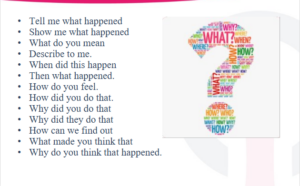
What questions can I ask if a child makes a disclosure?
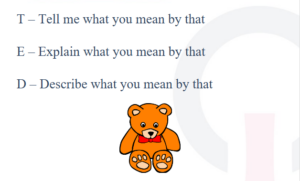
Ask open questions. The mnemonic ‘TED’ is useful as a guide:
Is there training on this?
Yes – see our Bitesize training Voice of the Child (Dec 2023)
What are Gillick Competency and Fraser Guidelines?
Gillick competency and Fraser guidelines help people who work with children to balance the need to listen to children’s wishes with the responsibility to keep them safe.
When practitioners are trying to decide whether a child is mature enough to make decisions about things that affect them, they often talk about whether the child is ‘Gillick competent’ or whether they meet the ‘Fraser guidelines’.
For more information: Gillick competence and Fraser guidelines | NSPCC Learning
Where can I find whistleblowing guidance?
Blowing the whistle to the Department for Education – GOV.UK
Training
| Training Provider | Types of Training |
|---|---|
| Cognus Education Safeguarding Team | For training delivered by the Education Safeguarding Team, please go to: https://suttontraining.event-booking.org/ and select ‘Cognus Safeguarding’ in the category section. For Bitesize Training slides and videos, please see: Bitesize Safeguarding Training |
| Sutton LSCP | 🌐Learning & Development Programme 📅Courses and events: Event List : Safeguarding Children (LSCP) 🎓E-Learning modules: Log In – Enable You will need to create an account first, then the modules will be free to access. 🔧Toolkits: Fire Prevention and Safeguarding Toolkit Child Safeguarding Toolkit Child Sexual Abuse 🌐Microsites: Learning from case reviews and multi-agency audits Child Protection Conference Microsite |
| London Safeguarding Children Partnership | To support Designated Safeguarding Leads to deliver Level 1 Safeguarding Children Training within their organisations, the London Safeguarding Children Partnership Training Managers Network has launched a Level 1 Safeguarding Children Training Pack – free to use. Level 1 Safeguarding Children: Training and bookings – London Safeguarding Children Board |
| DfE | Low Level Concerns Single Central Record Sexting/Online Harms Understanding AI in education: module 1 Interacting with generative AI in education: module 2 Safe use of generative AI in education: module 3 Use cases of generative AI in education: module 4 |
| LGFL | 🌐LGfL Safeguarding – Keeping Children Safe | LGFL 🎓Training Portal | LGFL (includes training for DSLs, staff and governors; topics include PREVENT, online safety, county lines, cybersecurity, neglect) |
| National Cyber Security Centre | Cyber security training for school staff – NCSC.GOV.UK |